Blog
Do We Need New Year’s Resolutions?
 We either pledge to start the new year with a new diet for weight loss, a fitness regimen to get in better shape, we embark on the “dry January” challenges to ditch all alcohol for a month; or we swear to give up junk food, late night snacking, late night-anything and so on.
While the above mentioned new year’s resolutions have been getting a bad rap because of their high failure rate, resolutions or goals or personal annual plans don’t have to run to the ground at the end of January. New year’s resolutions typically fail because they are based on unsustainable behaviors, goals that are too ambitious and unrealistic, not being specific and time-bound; not counting life events (birthday parties and holidays with the food they bring) and physical state (like being too tired to exercise at times). We get hung up on instant gratification and want to achieve our resolutions fast, believing that drastic measures will get us there, only to find that after some time (a month if not sooner) we rebel against our ambitious selves and break away from the darn resolutions.
What can we do instead to set and achieve out self-improvement goals? We have to be honest with ourselves, gauge our current state of being and where we want to be, be kind and patient with ourselves (but not pitiful), set out challenging but not daring goals and actions.
Approach goal-setting as seriously as a business plan or any other goal-setting and planning at work. Focus on making your goals SMART: Specific, Measurable, Attainable, Relevant and Time-bound. Use a daily and monthly planner to help you keep organized and on top of your plan. Analyze any set-backs, their reasons and ways to avoid them in the future. Try not to be overcritical with yourself if you are not following your plan as outlined, but rather identify the overpowering obstacles and tweak the plan to be more feasible and sustainable.
Let’s break it all down with an example – “get in better shape” resolution, or goal.
First and foremost, let’s bring the SMART acronym back and reshape the resolution, no pun intended, into a reasonable and deliverable form:
- Specific – “get in better shape” while being a great overall goal, lacks specificity – is it to be able to run a 5K or a marathon, is it to be able to walk without feeling breathless, or play with your kids or grandkids, or increase the load of a deadlift by 25%? For the sake of the example, I’d choose the goal to be able to run a 10 K (6 miles)– either in a race or on my own.
- Measurable – we can piggy-back from the above setting – 10 K (6 miles) – you can easily measure the distance for this running goal.
- Attainable – is 6 miles an attainable running distance for you? Only you would know. If you are already a runner and have done 5K runs (3 miles) before, than 10K is pretty feasible for you to do. If running is new to you, than a shorter distance would make more sense, and the goal should be adjusted back to, maybe, 5K.
- Relevant – is running a 10K relevant to the overall goal of getting gin better shape? It sure is! It contributes to your cardio-vascular health, strengthens muscles and bones, improves body composition and regulates mood.
- Time-bound – setting a time-frame to achieve your goal will help you stay on track. You may not set a realistic time-frame at first, depending on where you are at with running right now, however you can adjust your time as you get more familiar with your progress. Giving yourself 6 month may be too ambitious and leave you stressed and overtrained, or it may be just right to get you to the next running level. I would shoot for a longer time period and adjust it back if you feel that you can get there faster. It may be a good measure to go for 8 months to start with.
Now we can reframe the goal to sound like this:
I would like to improve my fitness level by training to run a 10K in 8 months.
I have found a very useful tool to try to help you set goals and resolutions – WOOP on Character Lab. WOOP stands for Wish, Outcome, Obstacle, and Plan. It was designed to be used at schools, however was tested in other settings and found to be helpful with productivity, self-improvement, goal achievement and organizational success. Try WOOPing for yourself to see if it helps with your resolutions this year.
Stay nourished my friends!
Check oUT OTHER RECENT POSTS

Diet Diversity Matters

Nutrigenomics, Epigenetics & Cancer Prevention



Hello, I’m Tatiana. I am a Licensed Dietitian Nutritionist and a Certified Nutrition Specialist.
I help people
- normalize their relationships with food,
- peel off the layers of misunderstood physical, nutritional and emotional needs,
- lose weight as a side effect of finding peace with food,
- stop obsessing about food and
- start living the freedom!
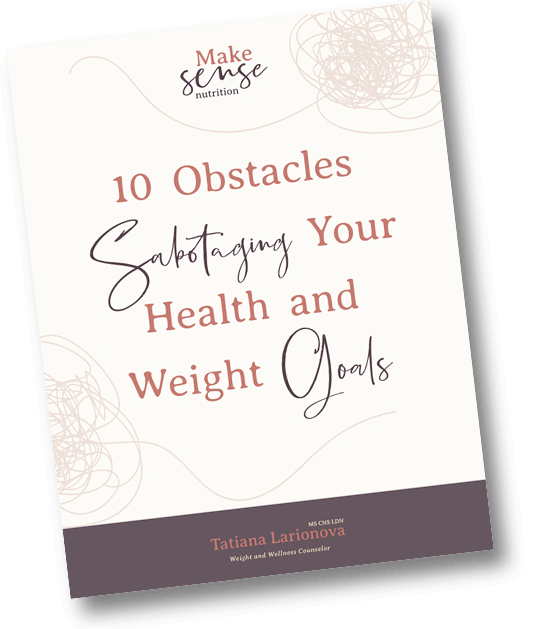
FREE DOWNLOAD
What stops you from getting in your best shape?
- Do you spend hours searching for the latest, most effective diet?
- Are you exhausted from using up so much energy and mental space on dieting and weight solutions?
- Are you uneasy around food and can’t seem to trust yourself to eat just enough for your body?
- Do you deal with challenges getting in the way of your healthy eating goals?
I’ve compiled this free tool - a list of 10 Obstacles Sabotaging your Health and Weight Goals that will help you pinpoint challenges you are dealing with that stop you from moving forward.